The Empty Fort Strategy — The Open Gate That Stopped an Army
From Chapter 95 of Romance of the Three Kingdoms
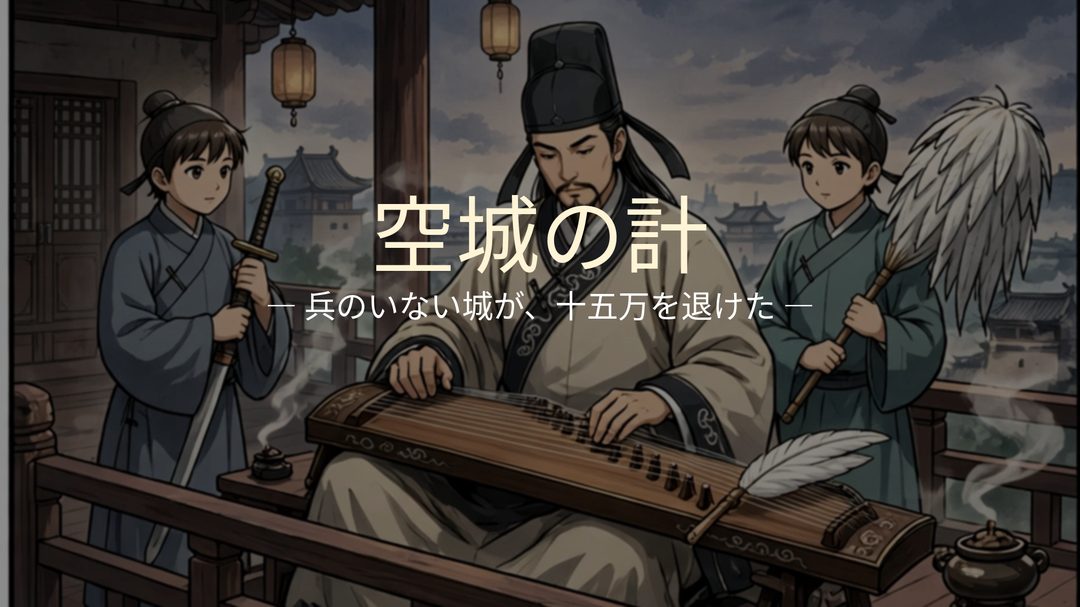
This is the story of how a town with no troops in it drove back a great army. The stage is the confrontation between Kongming, Shu's strategist, and Sima Yi, leading Wei's great army. On top of the town wall a lute sounds, and the town gates stand wide open. This is the Empty Fort Strategy, which repelled an army of 150,000 without fighting.
Watch the Video
Read the Comic
The Empty Fort Strategy
The Fall of Jieting
The Troops Left in Xicheng
The Contrivance of the Empty Town
Sima Yi's Judgment
The Reveal
The Difference from the Historical Record
Conclusion
Read the Text
The Empty Fort Strategy
This is the story of how a town with no troops in it drove back a great army. The stage is the confrontation between Kongming, Shu's strategist, and Sima Yi, leading Wei's great army. On top of the town wall a lute sounds, and the town gates stand wide open. This is the Empty Fort Strategy, which repelled an army of 150,000 without fighting. But this stratagem was born immediately after a great defeat.
The story begins with the struggle over a small strategic point called Jieting.
The Fall of Jieting
In the First Northern Expedition, Shu's army had advanced into the Longxi region. The key to cutting that line of advance was a place called Jieting. Kongming said:
KongmingJieting is small, but what hangs on it is of the utmost weight.
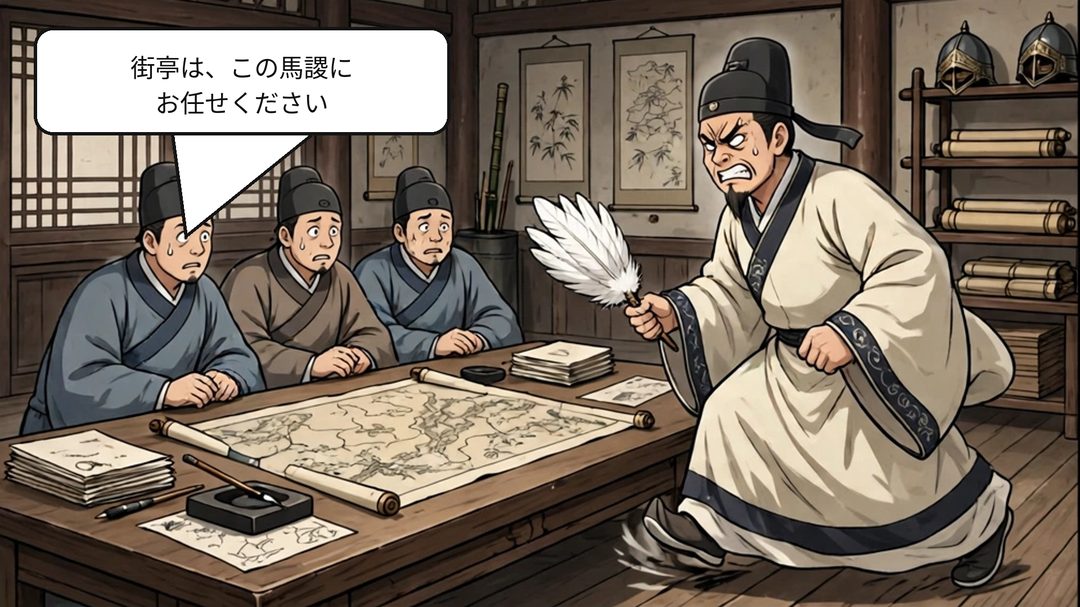
The man who volunteered for the defense was the staff officer Ma Su. Ma Su was well read in the military books, and undertook the task, even writing out a military pledge himself. Kongming gave him 25,000 picked troops, and attached the prudent Wang Ping to assist him. Kongming's instructions were clear: place the camp on the main road, and send a map of the terrain.
But Ma Su, seeing the ground, placed his camp not on the road but on top of a mountain. Wang Ping tried to stop him: on a mountain, the water route would be cut and the army would fall into disorder of itself. Ma Su would not listen. He brushed him aside, citing the art of war: place troops in a place of death and they will live. Wang Ping was given 5,000 troops separately, and made camp apart from the mountain.
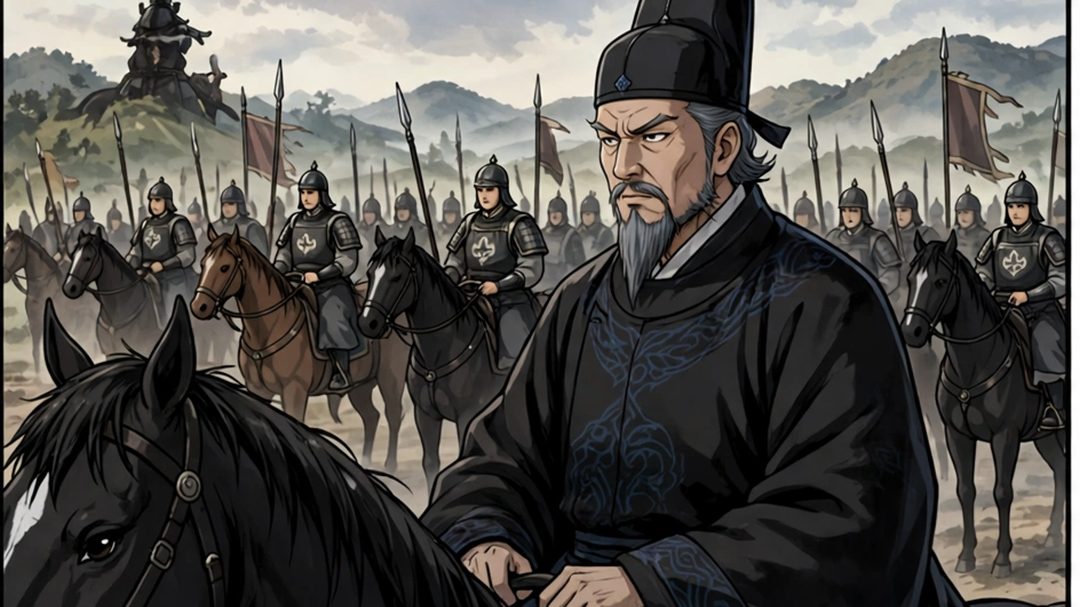
Sima Yi's side in Wei did not miss that movement. Sima Yi circled the mountain to view it, and confirmed that the troops were on the summit. What he ordered was to cut the road that drew water, and to surround the mountain on all four sides. Zhang He blocked the road by which Wang Ping would come, and the Wei army surrounded the mountain all at once.
The Shu troops on the mountain had no water, were short of food, and by night began to fall into disorder. Ma Su could not hold out, and fled down the mountain with the troops that remained. Both Jieting and Lieliu Town, the base for reinforcements, fell into Wei's hands.
The Troops Left in Xicheng
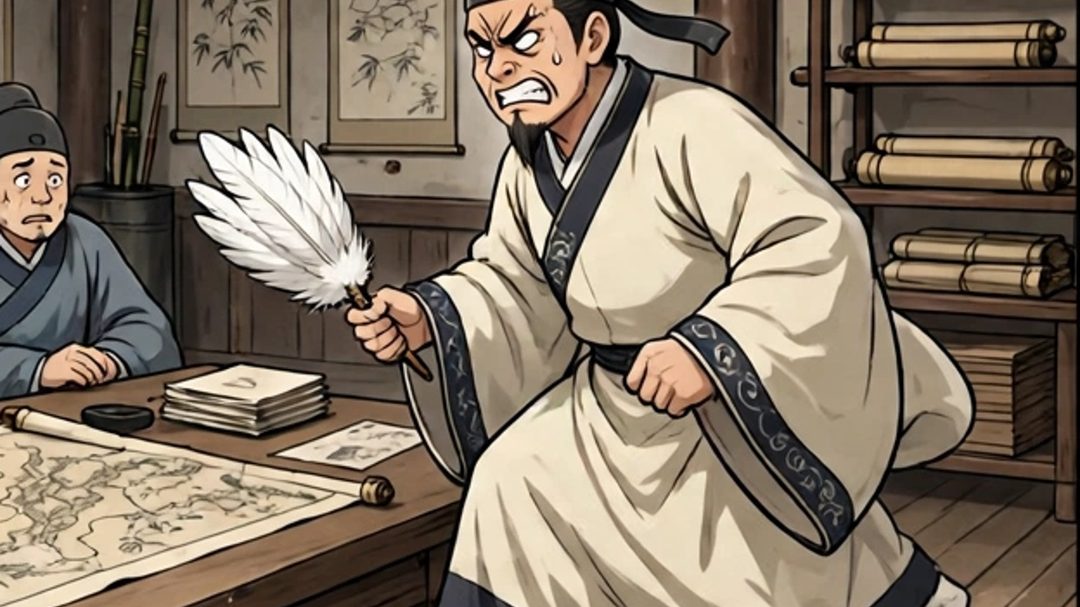
Receiving the report, Kongming stamped his foot and lamented: the great enterprise is lost — this is my fault. Kongming ordered the whole army to prepare to withdraw to Hanzhong. He himself took 5,000 troops and went to the town of Xicheng to transport provisions. But then, reports by fast horse arrived one after another.
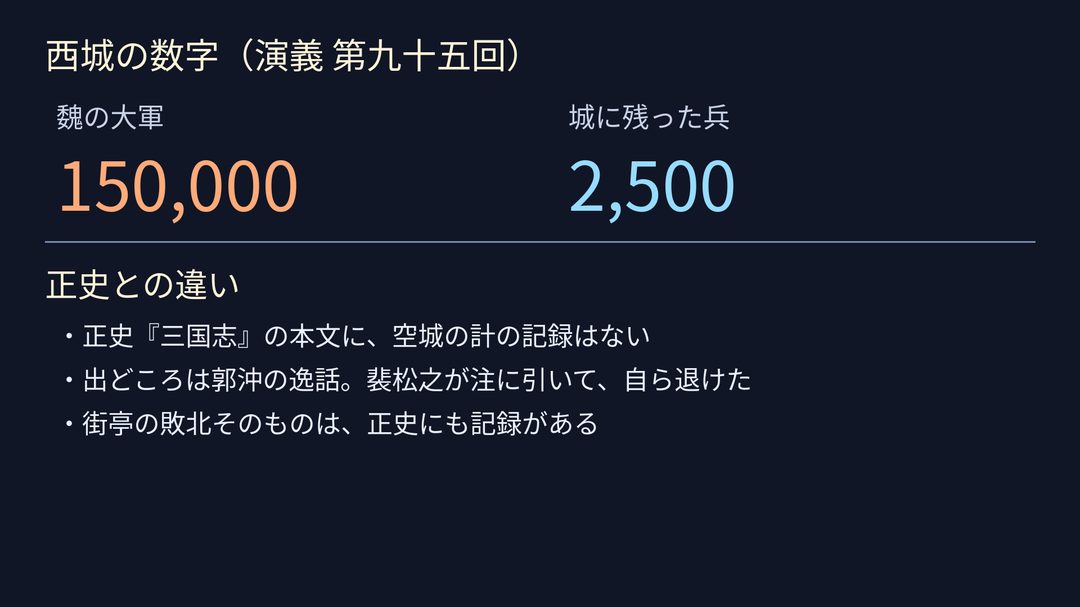
KongmingSima Yi is bearing down on Xicheng at the head of a great army of 150,000.
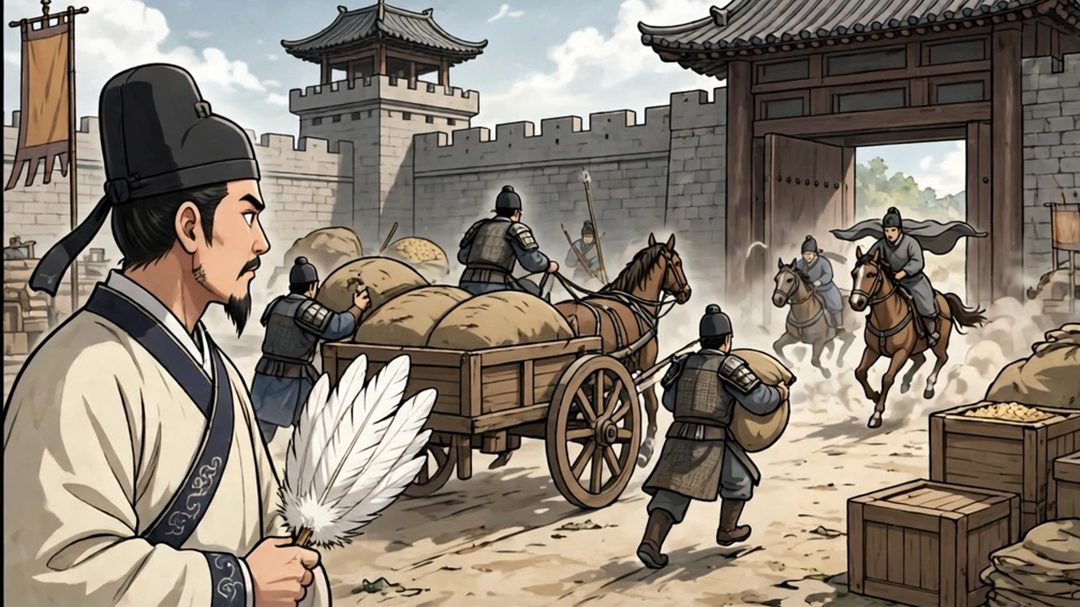
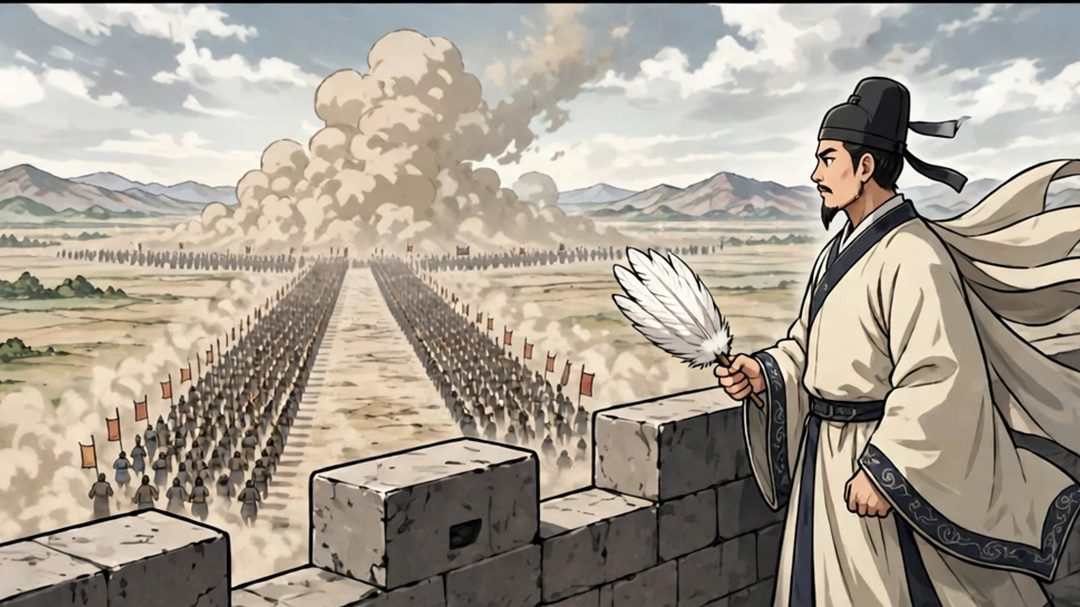
Half of the 5,000 troops had already gone ahead transporting provisions. Only 2,500 troops remained in the town. There was not a single general at his side; only civil officials remained. The civil officials who heard the report all turned pale. Kongming climbed the town wall and looked out. Dust rose to the sky, and the Wei army approached, divided into two columns.
With this strength, if they fled, they would soon be overtaken and captured. What Kongming chose here was to make the town look empty. No — to show the empty town exactly as it was.
The Contrivance of the Empty Town
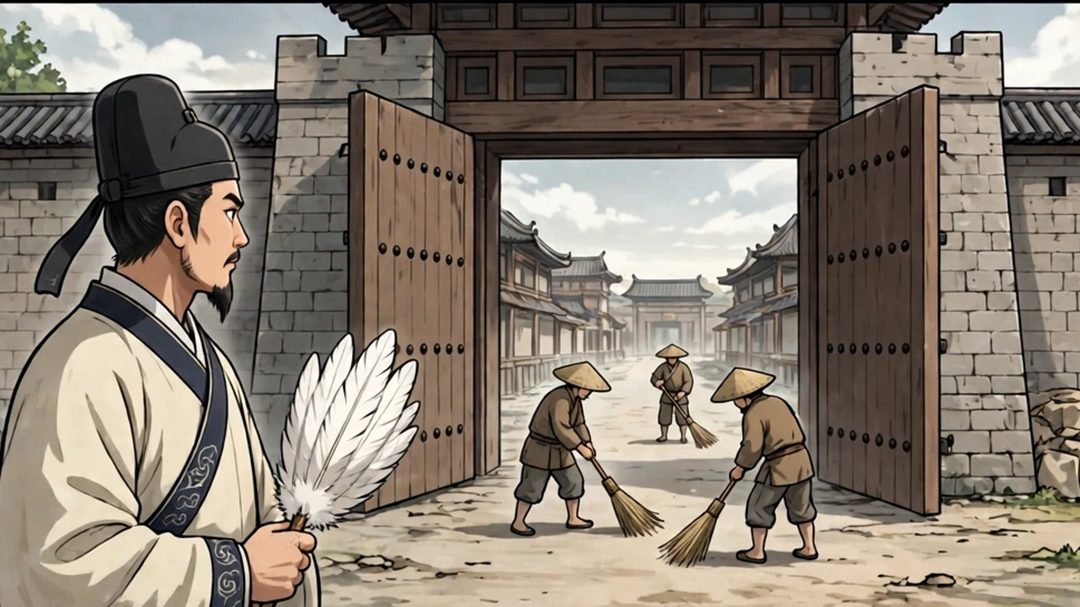
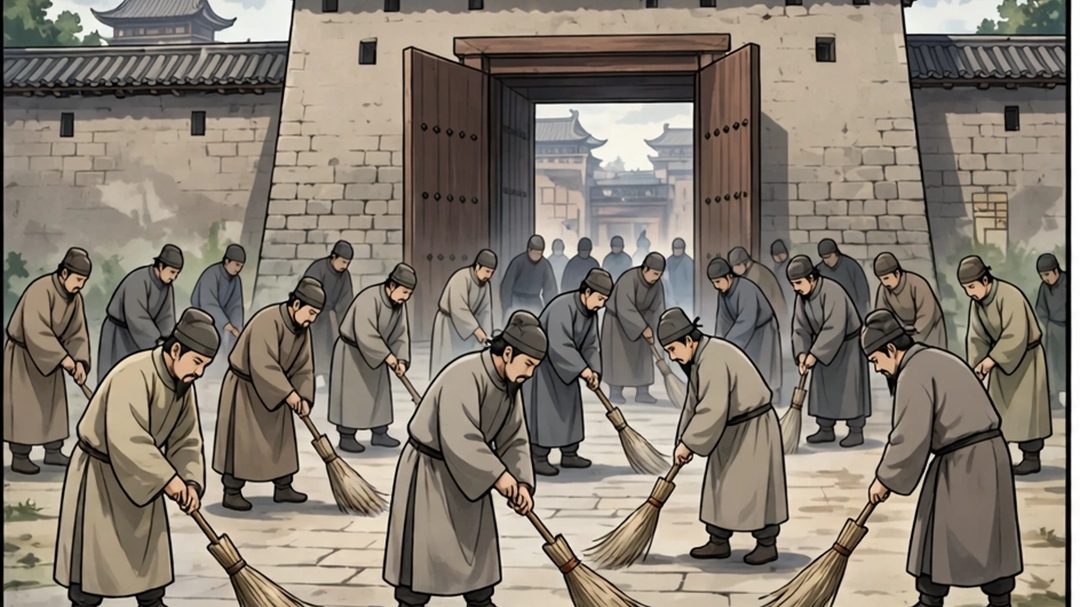
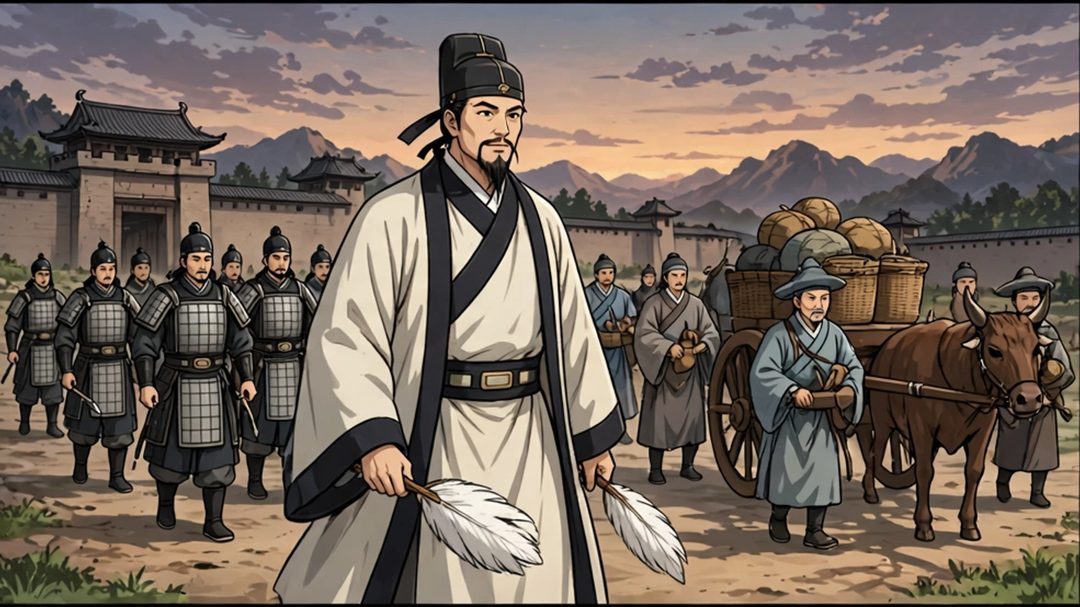
Kongming's orders were detailed, and thorough: every banner was to be hidden out of sight; the troops were not to leave their posts, and any who went in or out on their own or raised a loud voice would be beheaded; all four town gates were to be thrown wide open; at each gate, twenty soldiers were to be placed, dressed as common folk, to sweep the roads.
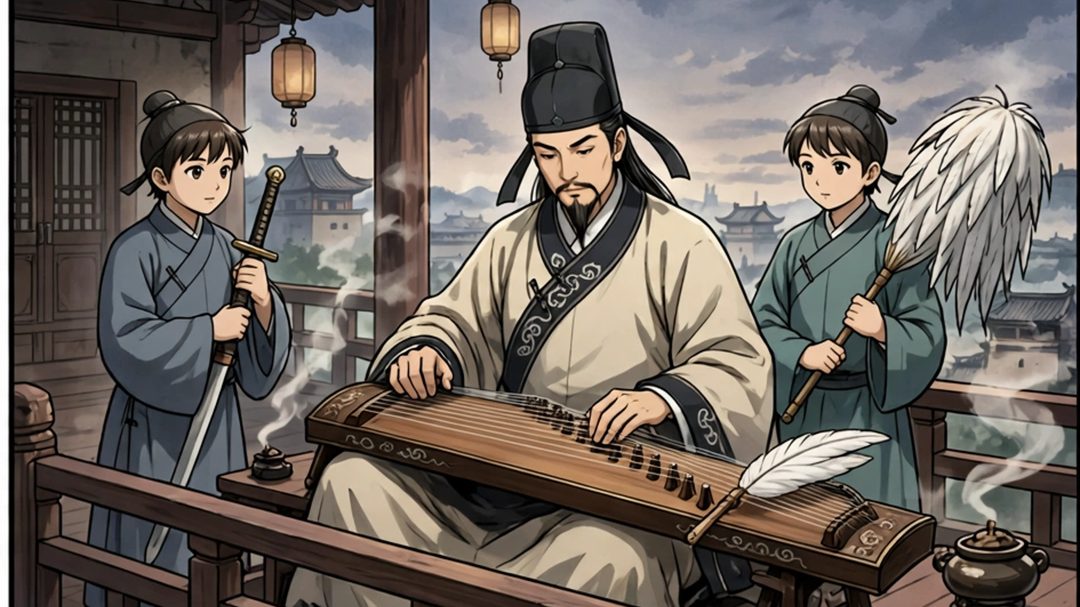
Even when the Wei army came, they were on no account to move in panic. And Kongming himself wrapped himself in a robe like crane feathers. Taking two young page boys with him and carrying a lute, he climbed to the tower above the town wall. Leaning against the railing, he sat, burned incense, and began to play the lute. The boy on his left held up a treasured sword; the boy on his right held a horsetail whisk.
Inside and outside the gates, some twenty common folk swept the roads with bowed heads. Quietly, steadily, as if no one were there. Within the town, every sign of an army's presence had been cleanly erased. It was a contrivance not to hide how few the troops were, but to erase the very existence of troops.
Sima Yi's Judgment
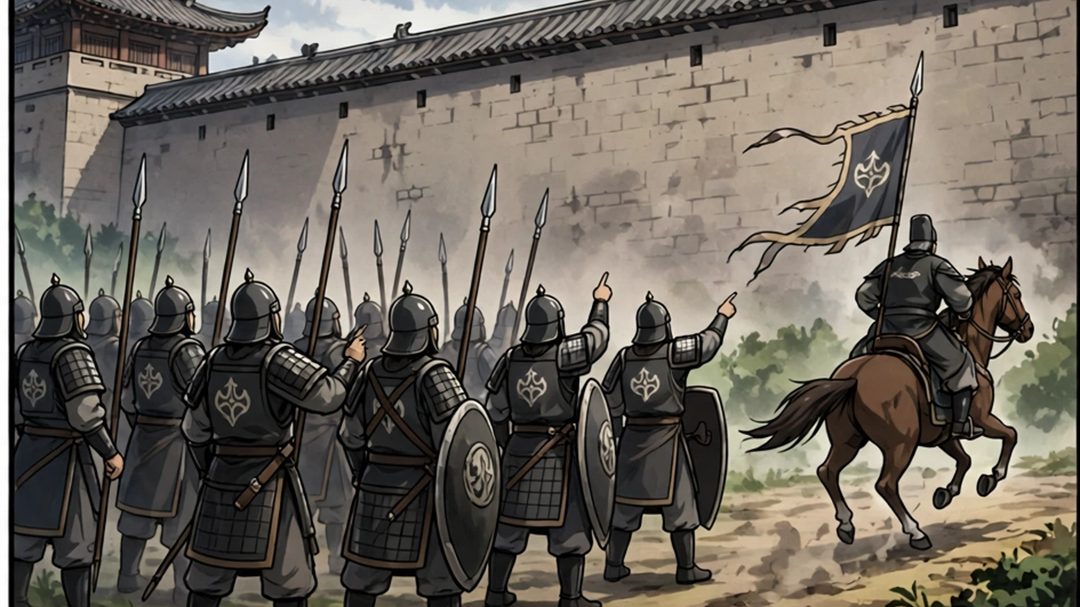
At last the Wei vanguard arrived beneath the town. What they saw was an open gate, common folk sweeping, and Kongming playing the lute. At the sheer strangeness of it, the vanguard could not advance, and hurriedly reported to Sima Yi. Sima Yi laughed in disbelief, halted the army, and looked for himself from afar.
What he saw was Kongming, smiling as he burned incense and played the lute. Inside and outside the town gates, common folk went on sweeping, as if there were no one around at all. Greatly suspicious, Sima Yi ordered the army to change direction.
Sima YiMake the rear army the front and the former front the rear, and withdraw toward the northern mountain road.
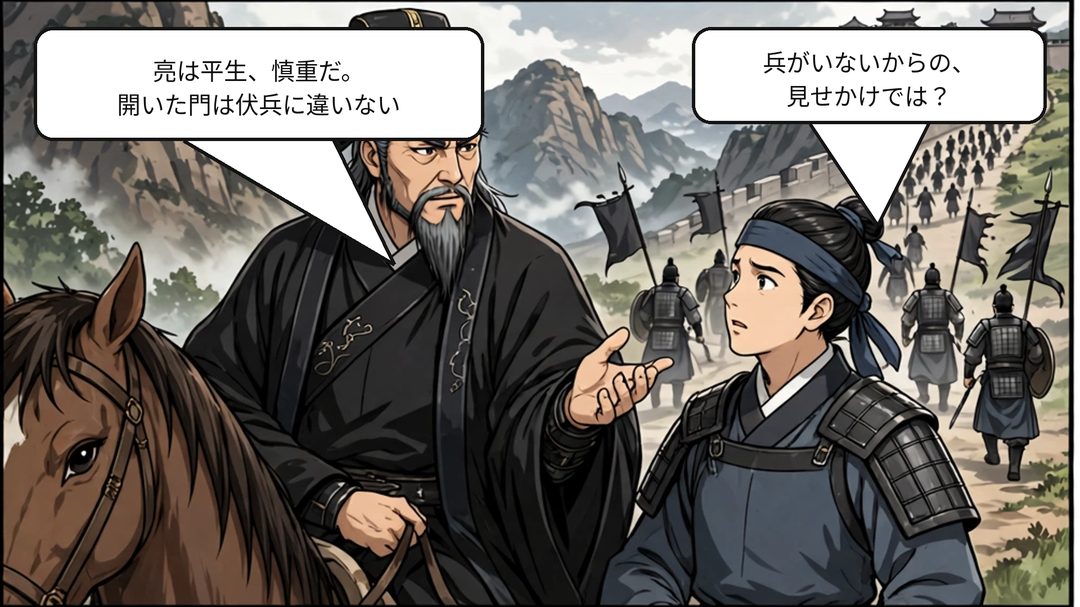
His second son, Sima Zhao, asked: might this not be a show precisely because there are no troops? Sima Yi's answer was his reading of the man Kongming himself. Kongming had always been prudent, and had never crossed a dangerous bridge. If that man threw the gates wide open, there must surely be an ambush.
Advance, and they would fall straight into his stratagem.
Sima YiWe have no choice but to withdraw.
The Wei army, which had come divided into two columns, withdrew in full, just as it was.
The Reveal
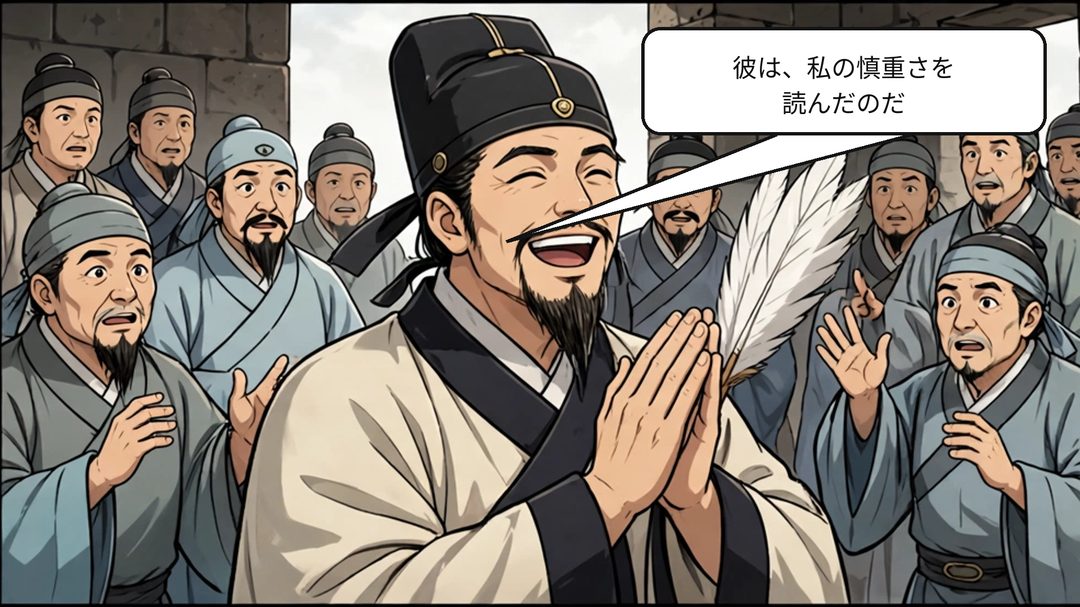
Watching the Wei army recede, Kongming clapped his hands and laughed. The civil officials were astonished and asked why the great army had withdrawn. Kongming's explanation was short: Sima Yi had read me as prudent, as a man who takes no dangerous chances. So, seeing that sight, he suspected an ambush.
Kongming also spoke frankly of his own position: it was not that I willingly played a dangerous hand. I used it because I had no choice. With 2,500 troops, even abandoning the town and fleeing, we could not have gone far. Rather than be captured, I had no choice but to stake everything on this one move. In other words, the Empty Fort Strategy was not a prepared marvel of a stratagem.
Cornered, he played a move relying only on the other side's reading of him. What Kongming read was not the army outside the town, but the inside of Sima Yi's head.
The Difference from the Historical Record
Here, let us make the difference from the historical record clear. The Empty Fort Strategy is not written in the main text of Records of the Three Kingdoms, the historical record. Its source is an anecdote about a man named Guo Chong, quoted in a commentary on the Biography of Zhuge Liang. Yet Pei Songzhi, who attached that commentary himself, rejected this anecdote.
At that time Sima Yi was far away in Wancheng, and was not in a position to confront him at Xicheng, he said. In other words, it is not an event that can be confirmed as historical fact. On the other hand, the defeat at Jieting itself is an event that is also recorded in the historical record. The Romance placed the empty-fort scene immediately after that defeat.
The figure playing the lute, and the details of the page boys and common folk, are scenes the Romance painted. So this story is to be savored as a reading of a story, not as historical fact. Yet the interest that remains lies in the mutual reading of the men — for it is a story in which Kongming's reputation for prudence itself became a weapon.
Conclusion
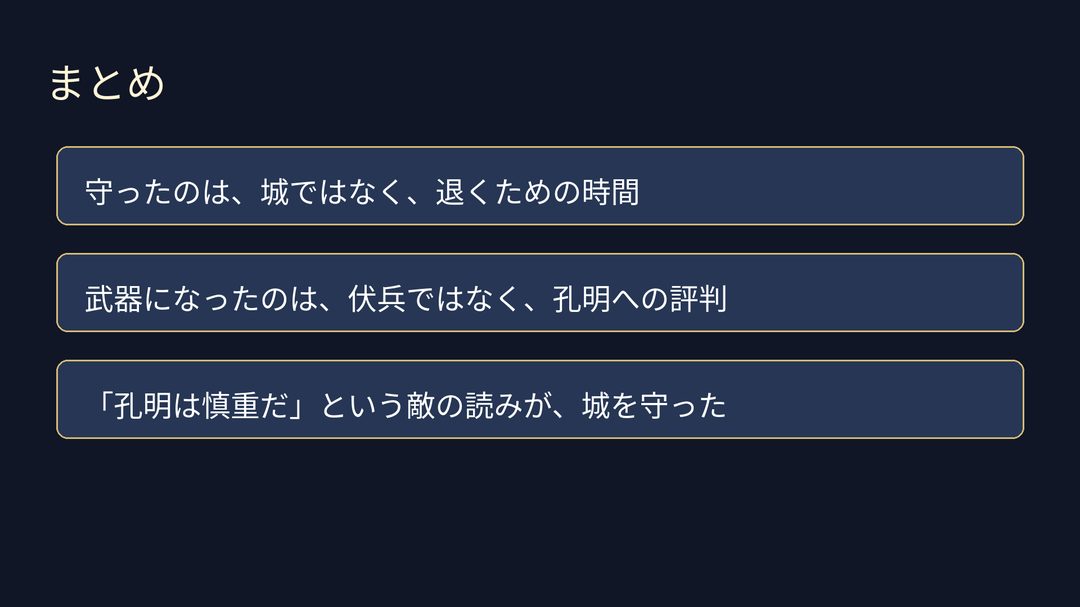
What the Empty Fort Strategy protected was not the town itself. It protected the 2,500 troops, and the time to withdraw to Hanzhong. His weapon was neither an ambush nor the town walls. It was the reputation, formed within the enemy, that Kongming is prudent. His greatest strength was that he had kept making them think so.
Conversely, Sima Yi's judgment cannot simply be called wrong either. If Kongming's ambush had really existed, the advancing army would have suffered a great wound. It was also the result of the reading that one does not approach an opponent one cannot fathom. The two men's readings collided, and the town remained without a fight.
“A three-foot lute surpasses a mighty host.” With that line, the Romance's poem closes the tale.
Sources and Basis
The Source Story
Based on the text of Chapter 95 of Romance of the Three Kingdoms, “Ma Su Refuses Counsel and Loses Jieting; the Martial Marquis Plays the Lute and Repels Zhongda” (the text collected on Wikisource, cross-checked against another edition). The numbers in the story, such as the size of the army Sima Yi led and the number of picked troops entrusted to Ma Su, are as they stand in the text.
Distinguishing the Romance from the Records
The Empty Fort Strategy is a scene known as an invention of the Romance. There is no record of this event in the historical record, and the course of the battle of Jieting also differs in detail from the Romance. This article introduces it in its original form, as a story of the Romance.