The Life of Zhao Yun — The Man Who Never Broke to the End
From Romance of the Three Kingdoms, Chapter 7 to Chapter 97, and the Biography of Zhao Yun in the official history Records of the Three Kingdoms
Zhao Yun was a general who stood out, even among the warlords of the Three Kingdoms, for how few defeats he had. More than the showiness of breaking great armies, the scenes that line his life are those of protecting what had to be protected, to the very end. At Changban he broke through the middle of the enemy holding his young lord in his arms, and on the Han River he drove back a great army with an empty camp. In the Northern Expedition of his later years, he turned the retreat of a lost battle into a retreat that lost not a single man or a single horse.
Seen not by how he won, but by the accumulation of judgments of not losing, Zhao Yun's life connects into a single line. Today, we will follow from Chapter 7 to Chapter 97 of the Romance, and trace that line. And where the records of the official history and the depictions of the Romance differ, we will speak of them separately each time.
Read the Comic
Panhe — The Young General's First Battle
Changban Slope — Holding A'dou
Judgments of Protection — Guiyang and Cutting Off the River
The Han River — The Stratagem of the Empty Camp
Remonstrance — The Role of Speaking to His Lord
Jigu — A Retreat That Was Not Made a Defeat
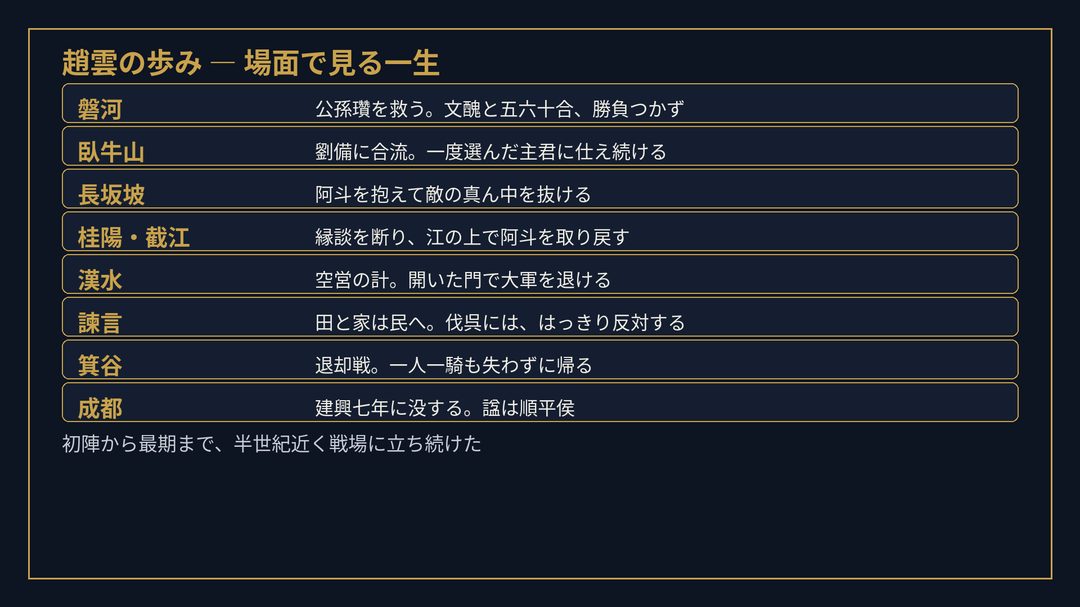
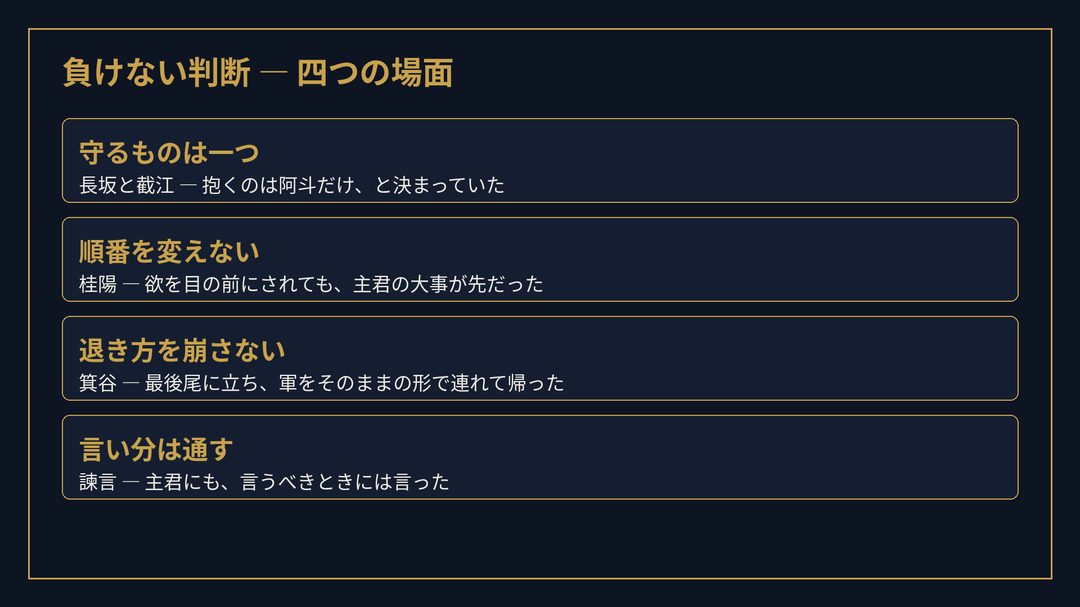
The End and a Summary — The Man Who Continued the Judgments of Not Losing
Read the Text
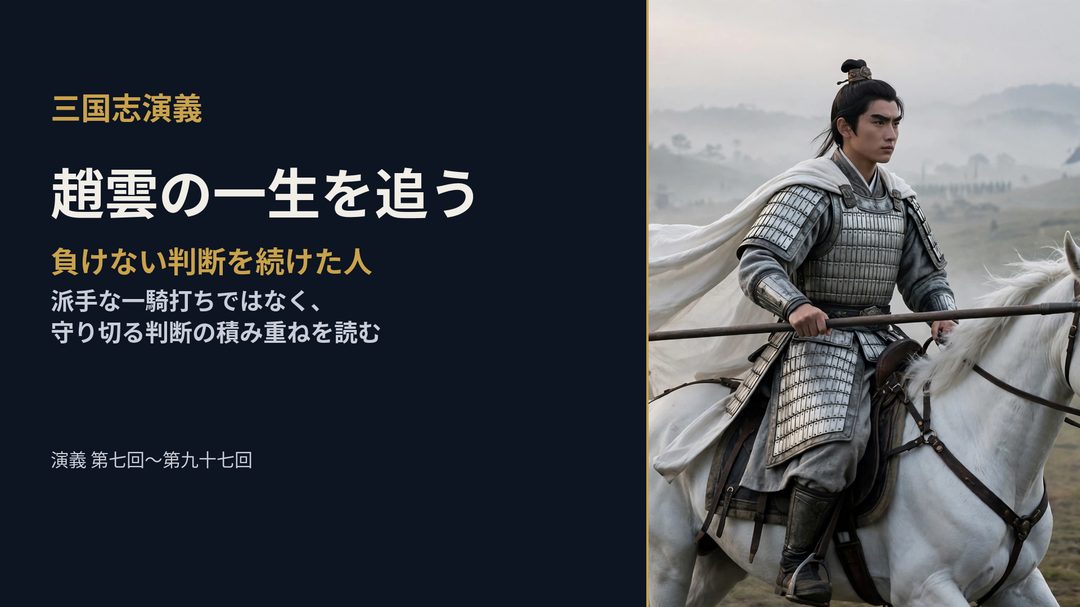
Panhe — The Young General's First Battle
Zhao Yun's first appearance is in Chapter 7 of the Romance. The setting is Panhe, the battle between Gongsun Zan and Yuan Shao. Gongsun Zan was being pursued by Yuan Shao's famed general Wen Chou; his horse was brought down and he fell below the slope. Just as Wen Chou was about to thrust his spear, a young general flew out from beside the grassy slope. Eight chi tall, with thick eyebrows and large eyes.
So the Romance writes, and brings Zhao Yun on stage. His bout with Wen Chou went fifty to sixty rounds. No decision was reached. When reinforcements arrived, Wen Chou withdrew, and Zhao Yun did not pursue. This way of conducting himself, without chasing too deep, is already visible in the scene of his first battle. Zhao Yun was originally on Yuan Shao's side.
But he turned away from him. Yuan Shao has no heart that cares for his lord and saves the people. That was the reason. His eye for choosing a lord was his first judgment. Gongsun Zan, too, did not employ Zhao Yun with any weight. Around that time, Zhao Yun met Liu Bei, who was visiting under Gongsun Zan.
The two hit it off, but Zhao Yun did not yet go to Liu Bei. In the parting scene, Liu Bei took Zhao Yun's hand and promised a day when they would meet again.
Reunion — To Liu Bei's Side
Several years pass, and Zhao Yun's figure disappears from the story. He next appears in Chapter 28. It was the period when Liu Bei, separated from Guan Yu and Zhang Fei, was in Runan. At a mountain called Mount Woniu, Zhao Yun cut down Pei Yuanshao, who had tried to steal a horse. And leading the forces of that mountain, he joined Liu Bei.
Liu Bei's joy was great, and the Romance writes that they rested in the same bed. From here, Zhao Yun becomes a general who never leaves Liu Bei's side. Not a showy progression from lord to lord, but serving to the end the lord he had chosen once. That was Zhao Yun's foundation.
Changban Slope — Holding A'dou
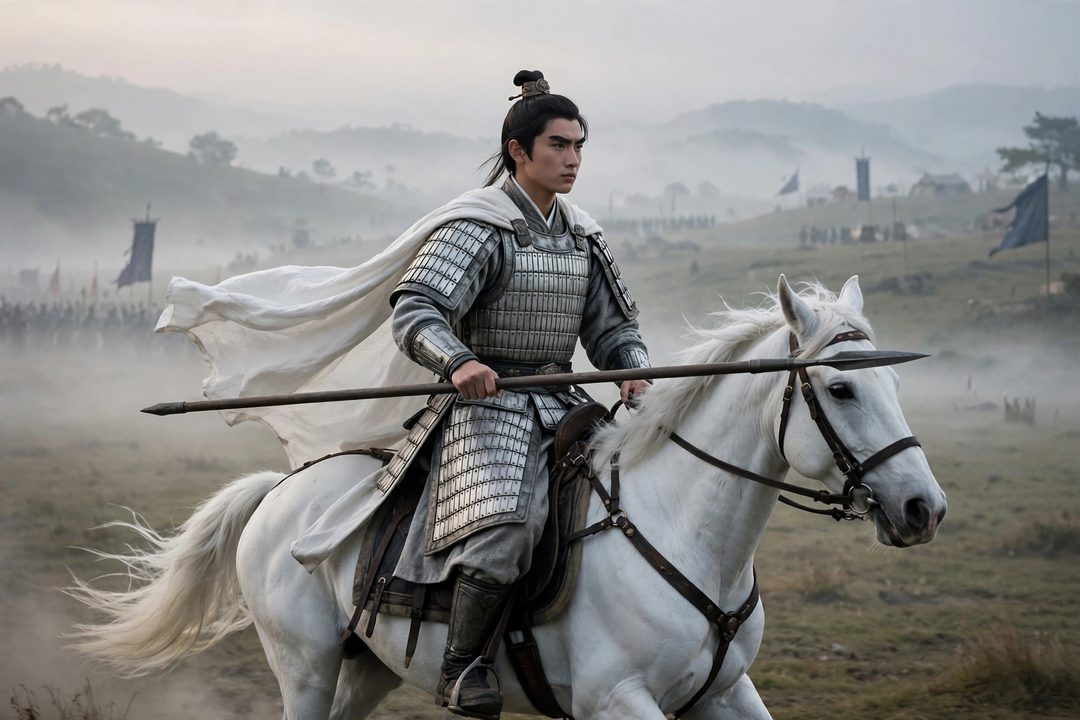
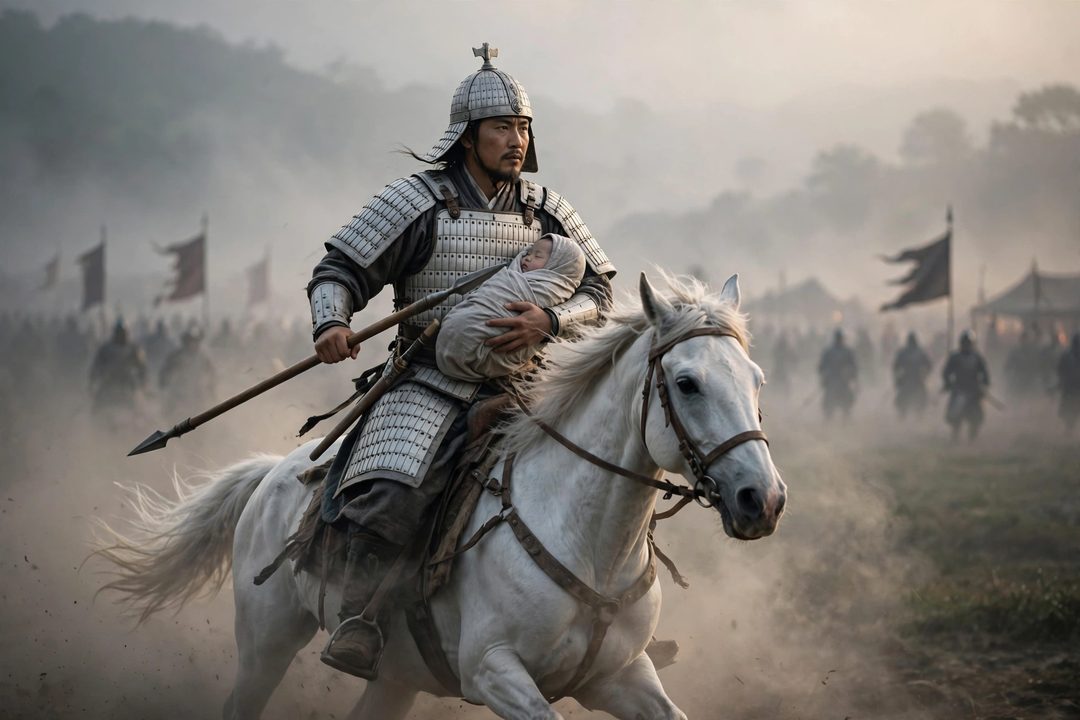
Jian'an 13, the year 208. Cao Cao's great army came down into Jing Province, and Liu Bei was caught up with at Changban in Dangyang. In the confusion, he was separated from his family. The one entrusted with their protection was Zhao Yun. Alone, Zhao Yun turned his horse toward the north, from which the enemy was surging in. First he rescued Lady Gan, and then pursued the whereabouts of Lady Mi and A'dou.
Lady Mi had taken an arrow wound, and beside a dry well, she entrusted A'dou to Zhao Yun. Then, fearing that A'dou's crying would call the enemy, the lady threw herself into the well. Zhao Yun pushed down the well's earthen wall to cover it with earth, removed the breastplate of his armor, and took A'dou back into his chest.
From here on, it is a battle of protection. Zhao Yun drove back, one after another, the enemy generals who blocked his path. It was also on this road that he cut down Xiahou En, who carried a sword on his back, and seized the Qinggang sword. Cao Cao, watching this fight from atop a hill, asked his name. Changshan's Zhao Zilong, the answer came back. Cao Cao's words are famous.
That is a tiger of a general.
Cao CaoTake him alive.
That he even issued the order not to shoot cold arrows ended up saving Zhao Yun's life instead. Chapter 42 of the Romance concludes this scene by saying that he cut down more than fifty of Cao's famed generals. At Changban Bridge, Zhang Fei was waiting, and Zhao Yun crossed the bridge still holding A'dou. When he delivered A'dou to Liu Bei, Liu Bei threw A'dou to the ground, the Romance writes.
Because of you, I nearly lost a great general, he said. More than how Zhao Yun answered those words, his subsequent life is the answer.
Judgments of Protection — Guiyang and Cutting Off the River
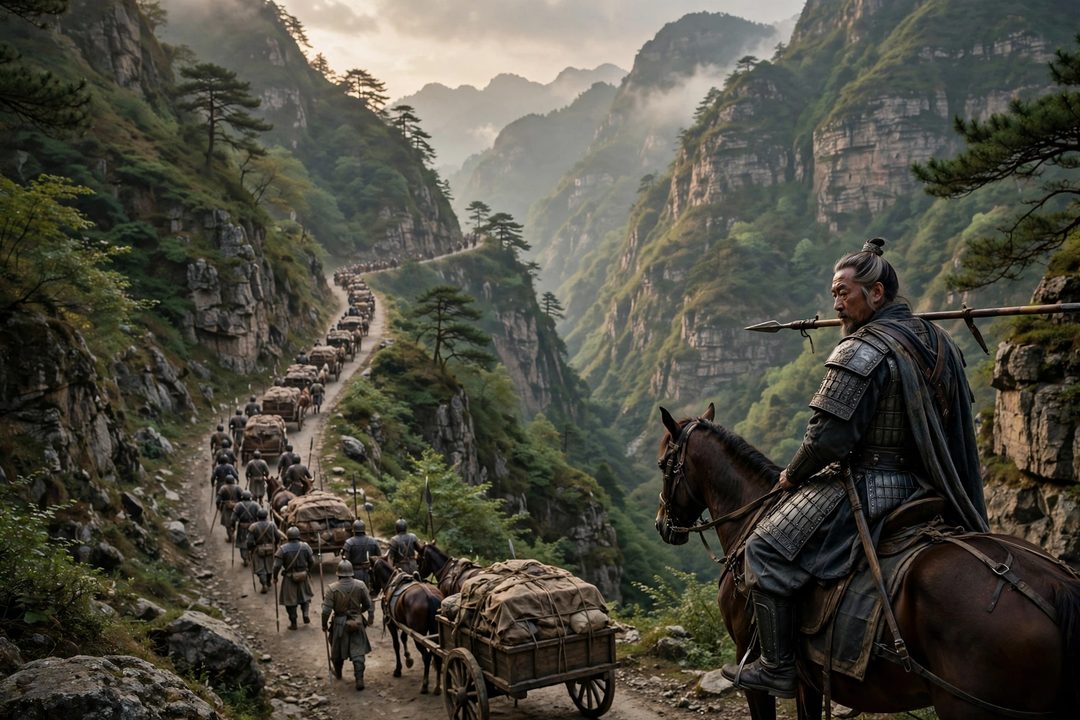
After Changban, Zhao Yun's judgment was tested off the battlefield as well. After Red Cliffs, the one who went to take Guiyang, leading 3,000 soldiers, was Zhao Yun. Zhao Fan, the Grand Administrator of Guiyang, surrendered without fighting, and, as fellow men of the same home region, they swore an oath of brotherhood. What Zhao Fan then brought up was a marriage proposal with Lady Fan, the wife of his late elder brother.
Zhao Yun refused in anger. He put the reasons into clear words, three of them: to take the wife of his sworn elder brother as wife would invite people's ridicule; a remarriage would make the lady lose her fidelity; and the heart of Zhao Fan, who had only just surrendered, could not yet be measured. He also said that in a time when his lord's great enterprise was not yet settled, he could not ruin himself over a single lady.
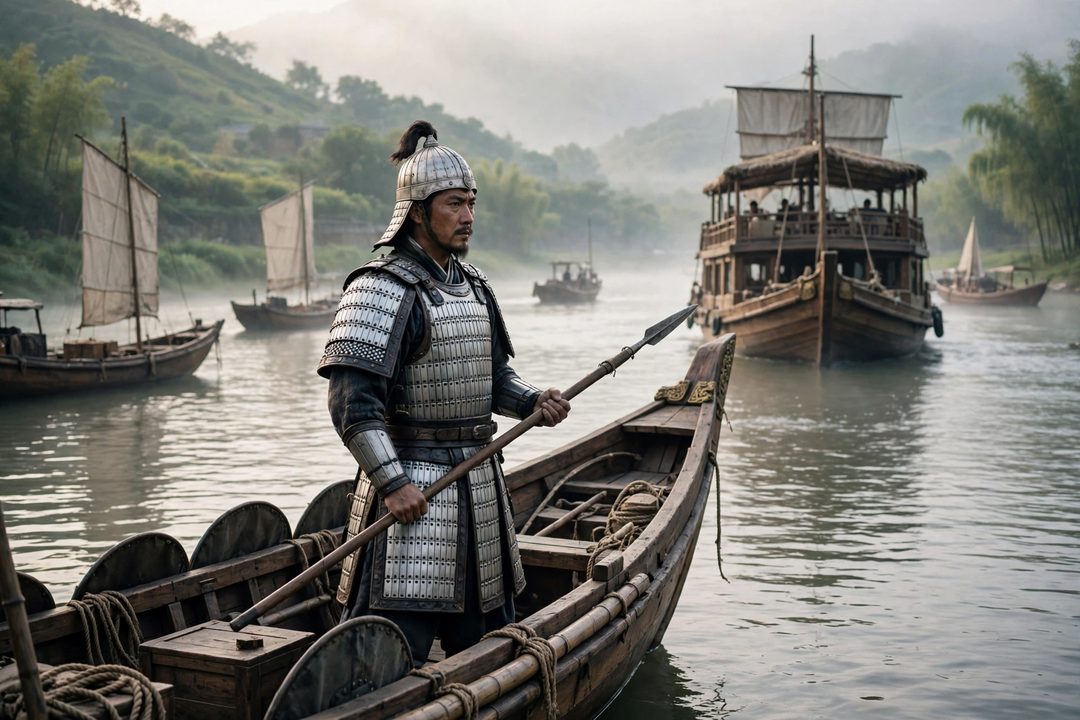
Hearing this, Liu Bei appraised him: Zilong is a true man of resolve. Even with desire placed before his eyes, he did not mistake the order of things. This too was one of his judgments of not losing. The other was on the Yangtze. It happened while Liu Bei had gone to Yi Province. Lady Sun set out by boat, taking the seven-year-old A'dou with her, to return to Wu.
With four or five riders, Zhao Yun raced along the riverbank, leapt aboard the boat, and took A'dou into his arms. There was also a scene in which Zhang Fei cut down Zhou Shan, of Lady Sun's escort, but the two did not pursue the lady herself. To drive the lady to her death is not the way of a subject. Taking only A'dou, they left the boat.
The line between what is to be protected and what need not be protected runs straight through here as well.
The Han River — The Stratagem of the Empty Camp
Jian'an 24, the contest for Hanzhong. In Chapter 71 of the Romance, there is another famous scene of Zhao Yun. The veteran general Huang Zhong attacked Wei's grain stores, was late in returning, and was surrounded by the enemy. Zhao Yun led his soldiers into the encirclement and rescued Huang Zhong. On the way back, he also pulled his deputy Zhang Zhu out from inside the encirclement once more.
Cao Cao's pursuing army pressed close to his own camp. His officer Zhang Yi proposed a plan to close the gates and defend. Zhao Yun's answer was the opposite.
Zhao YunDo not close the gates.
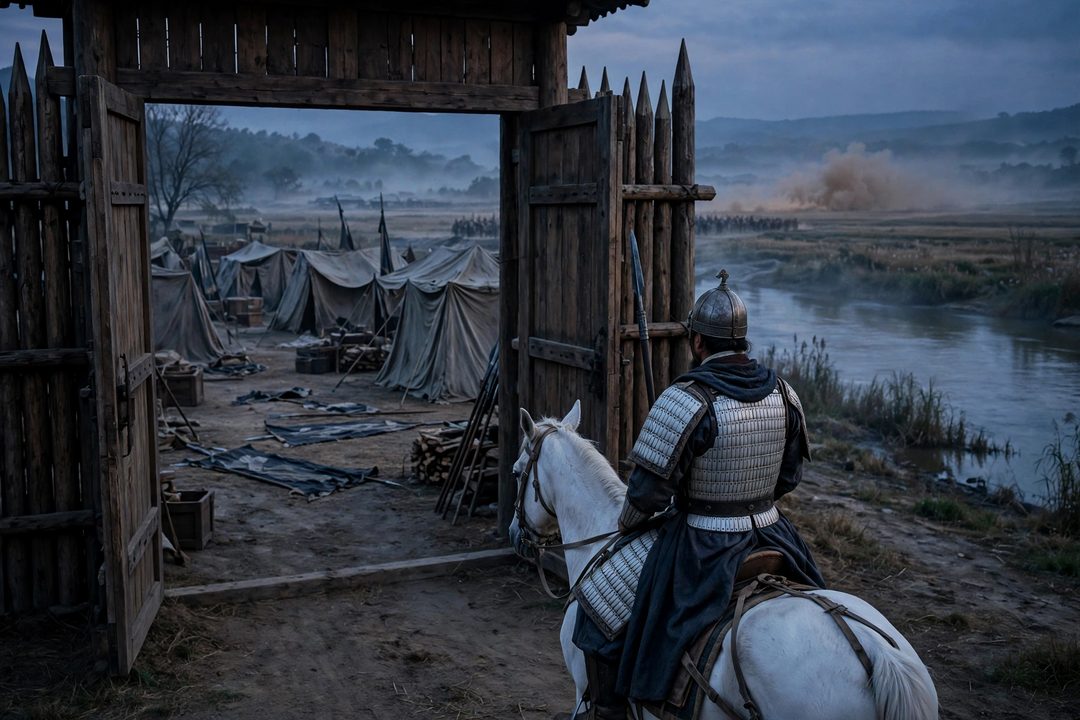
He spoke in the manner of saying: I, who at Changban looked on an army of 830,000 as grass — what would I fear now? He had all the camp's banners and spears laid down, and ordered that the drums not be sounded either. He hid his archers in the moat outside the camp, and himself stood alone, on a single horse, outside the open gates. The Wei army, arriving at dusk, saw the silent camp and the wide-open gates, and could not advance.
Even when Cao Cao himself came and urged the advance, the soldiers, seeing Zhao Yun alone before the gates, turned back. At that instant, arrows were loosed all at once from the moat, and drums resounded from deep within the camp. The Wei army, fearing an ambush, broke and poured into the Han River, and those who drowned in the river were beyond counting. The next day, Liu Bei's words, seeing the battlefield, decided the name of this chapter.
Zilong is gall through and through, he said. That gall was different from recklessness. It was gall that had read everything — the opened gates, the hidden archers, and even the dimness of dusk.
Remonstrance — The Role of Speaking to His Lord
Zhao Yun also bore the role of speaking his opinion to his lord. After Chengdu fell, talk arose of giving the retainers fine houses and fields. Zhao Yun stopped it. The people of Yi Province have only just suffered from war. The houses and fields should be returned to their owners, he said. The other occasion was after Guan Yu's death.
It was when Liu Bei was about to attack Wu. Zhao Yun remonstrated. The traitor to the state is not Wu, but Wei. If Wei is attacked first, Wu will submit of its own accord, he said. This remonstrance was not accepted, and Liu Bei was badly defeated at Yiling. Zhao Yun was entrusted with the rear, and received the defeated Liu Bei at Yong'an. In the sense that his opinion did not get through, Zhao Yun had defeats too.
Even so, he spoke when he should speak, and did not let the post left to him collapse. That, too, was this man's consistent way.
Jigu — A Retreat That Was Not Made a Defeat
After Liu Bei's death, Zhao Yun took part in Kongming's Northern Expeditions. Jianxing 6, the year 228. Chapter 92, the battle of Mount Fengming. The veteran general, written as seventy years old, faced Han De and his sons of Xiliang. He cut down Han De's four sons one after another, and at last cut down Han De himself. Five generals cut down in all.
That is the name this chapter bears. But Zhao Yun's true showcase comes after this showy battle. Zhao Yun and Deng Zhi advanced to Jigu as a decoy force, and took on the great army of Wei's Cao Zhen. Because the main force was defeated at Jieting, the army at Jigu was also forced to retreat. In numbers of soldiers, they were greatly inferior.
Zhao Yun himself remained at the very rear, and sent Deng Zhi ahead with the soldiers. Before the pursuing Wei army, Zhao Yun showed himself again and again, dulling the pursuers' feet. Kongming, who counted the army that had returned to Hanzhong, was astonished. Zhao Yun's army alone had not lost a single man or a single horse. It had not discarded a single piece of baggage or a single weapon either.
Deng Zhi's explanation was brief. It was because Zilong alone guarded the very rear, he said. Kongming offered a reward of gold and silk, but Zhao Yun did not accept it. If there is a reward for a lost battle, the logic of reward and punishment does not hold. Put the silk in the storehouse, and turn it to the winter issue, he asked. After this, Zhao Yun, as the general of a defeated army, was lowered in rank to General Who Guards the Army.
He accepts responsibility. He does not accept the reward. The way this retreat battle ended tells the whole of this man.
The Official History and the Romance — The Core Was on the Side of the Historical Record Too
Here, let us draw a line between the official history and the Romance. That he protected A'dou in his arms at Changban is itself recorded in the Biography of Zhao Yun in the official history. The figure of more than fifty of Cao's famed generals cut down, and the scene of Lady Mi throwing herself into the well, are embellishments of the Romance. Both the story of refusing the marriage with Lady Fan at Guiyang and the stratagem of the empty camp on the Han River have a core in the official history and its annotations.
Liu Bei's words, that Zilong is gall through and through, are also words preserved in the Separate Biography of Zhao Yun, quoted in the annotations to the official history. That at Jigu he himself served at the very rear and lost almost none of the army's materiel is also clearly stated in the Separate Biography. In other words, the core of Zhao Yun — the judgments of not losing — is not a false image created by the Romance.
The Romance, on top of the core in the official history, fleshed it out with scenes and lines, and gave that judgment a visible form. The age of seventy given in the Romance, incidentally, cannot be verified: in the official history, the year of his birth is unknown.
The End and a Summary — The Man Who Continued the Judgments of Not Losing
Zhao Yun's death is placed in Chapter 97 of the Romance. Before the second Northern Expedition, at a banquet, Zhao Yun's two sons arrived with news. Their father had died of illness the night before, they said. Kongming dropped his cup to the ground and wept, saying the state had lost its main beam, and I have lost an arm. Liu Shan in Chengdu also raised his voice and wept.
When I was small, if not for Zilong, I would have died amid the chaotic army, he said. In the Romance, it is written as if the rank of Grand General was bestowed at once. The posthumous name Shunping Hou was also bestowed in the same scene. In fact, the posthumous name was bestowed, in the official history, much later. It was Jingyao 4, the year 261.
The year of his death is given in the records of the official history as Jianxing 7, the year 229. Let us line it up. He chose his lord only once, and what he protected was always fixed as one thing. Even with something he wanted placed before him, he did not change the order; in scenes of victory, he did not chase too deep. In scenes of defeat, he stood at the very back and brought the army home in its intact shape.
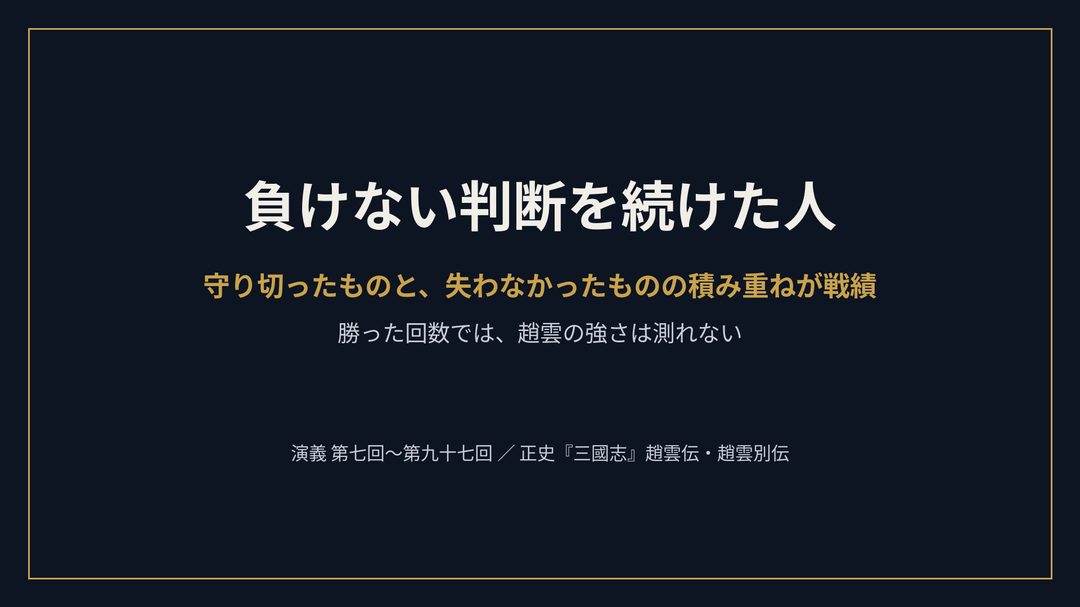
Zhao Yun's strength cannot be measured by the number of victories. The accumulation of what he protected to the end, and of what he did not lose, is this man's battle record. Zhao Zilong of Changshan. He was a general who continued the judgments of not losing, from beginning to end.
Sources and Basis
Source material
Based on Zhao Yun's appearances from Chapter 7 to Chapter 97 of Romance of the Three Kingdoms (checked against Wikisource and other sources), and on the Biography of Zhao Yun and the Separate Biography of Zhao Yun in the official history Records of the Three Kingdoms. Descriptions such as "eight chi tall, with thick eyebrows and large eyes" and the expression "fifty to sixty bouts, the contest undecided" are as in the original text.
Distinguishing the Romance from the official history
The rescue of A'dou at Changban has a core in the official history as well. On the other hand, the details of his many lone charges are the Romance's way of depicting them. The text distinguishes the sources.