The War of Words before Red Cliffs — The Man Who Broke the Case for Surrender with Words
From Chapter 43 of Romance of the Three Kingdoms
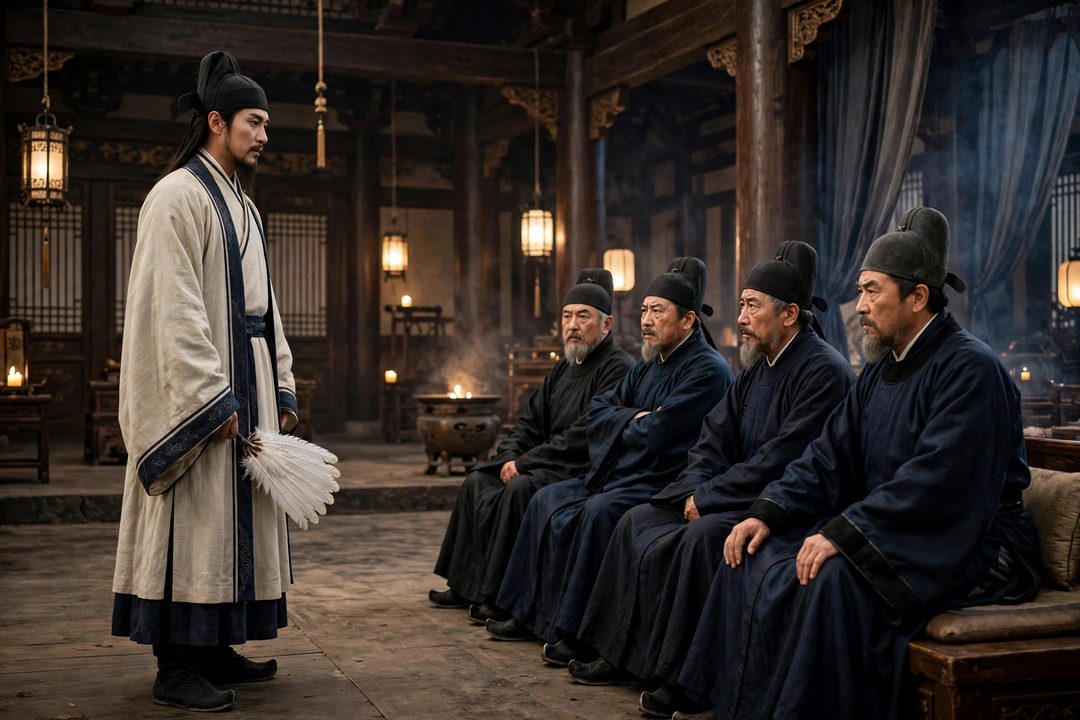
Before the Battle of Red Cliffs in Romance of the Three Kingdoms, there was a discussion that decided the outcome without fighting. Zhuge Liang (Kongming) rode alone into the Wu court and exchanged words with its senior officials — the so-called war of words. This scene is often told as a scene of refutation, in which Kongming talked his opponents down.
But looked at closely, what Kongming did was not refutation. He rebuilt the other side's very calculation of gain and loss. Not silencing the other side, but rewriting the calculation inside them — that was Kongming's way. Today we dissect that rebuilding, one piece at a time.
Watch the Video
Read the Comic

The Situation: Liu Bei Cornered, and Kongming's Mission
The Senior Officials' Calculation: Surrender to Avoid Loss
Rebuilding, First Half: One's Standing after Surrender

Rebuilding, Second Half: Recounting the Reasons They Could Fight
Sun Quan's Decision: Gain and Loss, and a Lord's Standing
Conclusion: Three Patterns of Negotiation
Read the Text
The Situation: Liu Bei Cornered, and Kongming's Mission
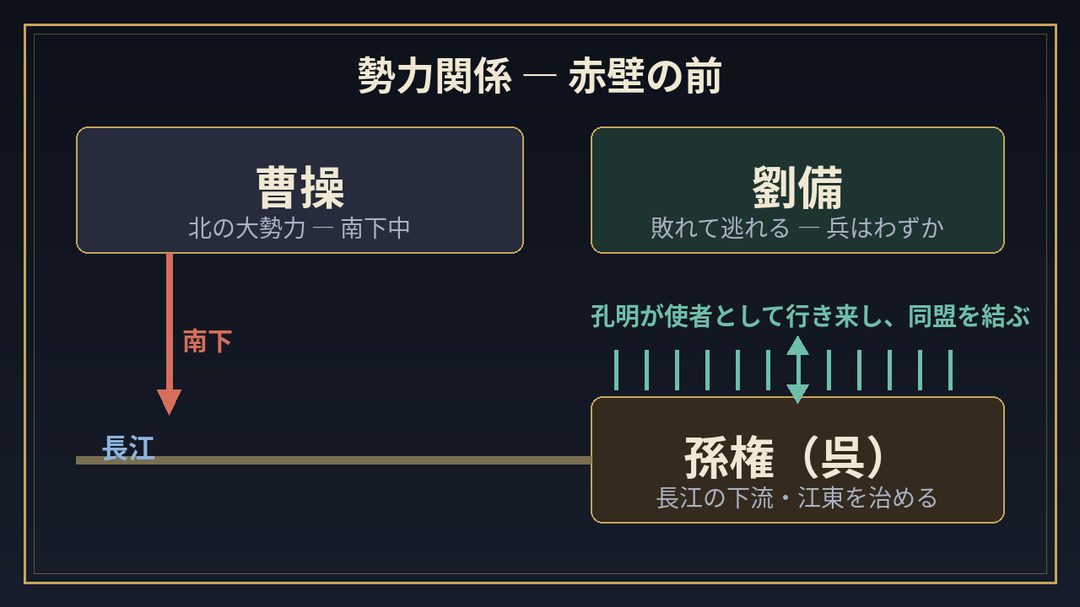
The stage of the story is just after Cao Cao led a great army south and took Jing Province into his hands. The defeated Liu Bei fled with only a few troops, and left as he was, he would be swallowed up by Cao Cao. So Kongming went, as Liu Bei's envoy, to Sun Quan, who ruled the lower reaches of the Yangtze.
There was one aim: an alliance of Wu and Liu Bei, in which Sun Quan and Liu Bei would join hands. But at the Wu court, even before any fighting, an air of surrender had already spread. Across the Yangtze, Cao Cao in the north, Sun Quan in the south, and the fled Liu Bei — three powers stood on the verge of collision. The senior officials who received Kongming showered him with questions one after another, trying to make Liu Bei's strength look small.
The Senior Officials' Calculation: Surrender to Avoid Loss
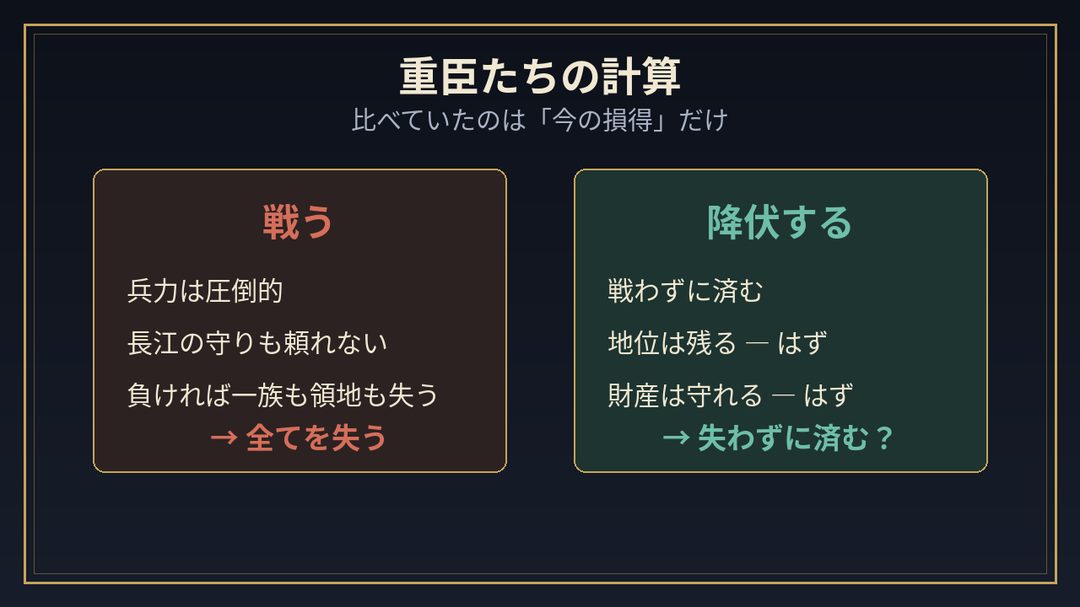
Zhang Zhao and the other central senior officials were plainly urging Sun Quan to surrender. Their reason was not emotion but calculation. The view that Liu Bei had only a small force also backed the senior officials' calculation. Cao Cao's military strength was overwhelming, and the defense of the Yangtze could no longer be relied on now that Cao Cao had gained Jing Province's navy.
Fight, and they would lose. Lose, and they would lose both clan and territory. Surrender early, then, and their present positions and property should be preserved. That was the senior officials' reckoning of gain and loss — a surrender not to avoid losing, but to avoid losing what they had. What stood in Kongming's way was not a sword, but this calculation.
Kongming did not flatly deny that calculation. He first stood on the other side's ground, and then rebuilt it — that is the cleverness of this war of words.
Rebuilding, First Half: One's Standing after Surrender
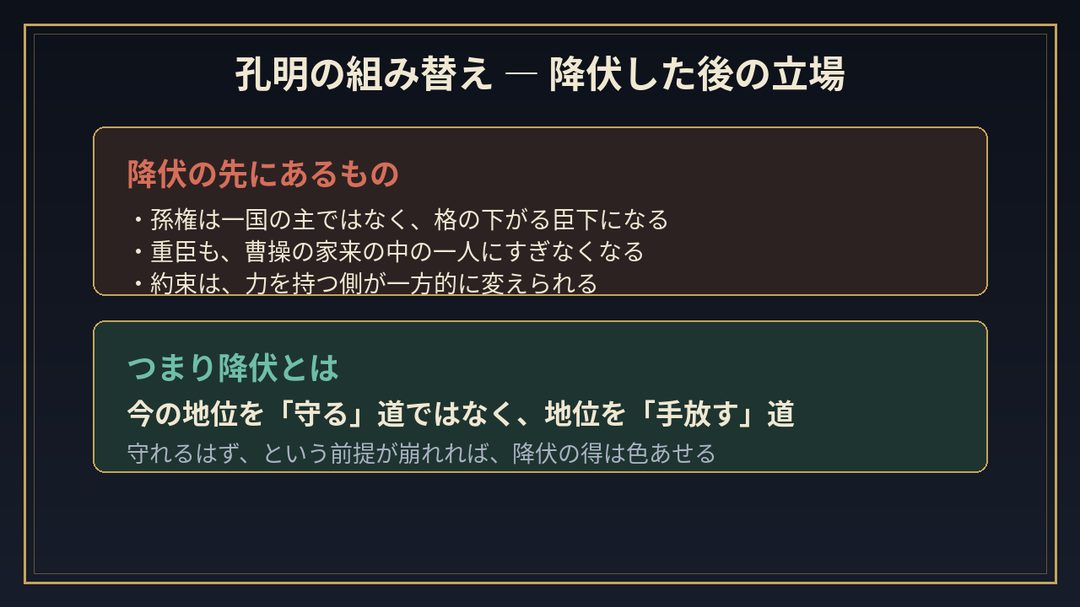
Kongming first moved to break the foundation of this calculation. What the senior officials were comparing was only the immediate gain and loss of fighting versus surrendering. Into that, Kongming brought a new measure: one's standing after surrendering. Surrender, and Sun Quan would cease to be the lord of a state.
He would become a subject of lower rank under Cao Cao. The same held for the senior officials. Senior officials of Wu now, beyond surrender they would be no more than one retainer among Cao Cao's men. Moreover, how long those who surrendered would be employed with weight was for Cao Cao's side, which held the power, to decide. Promises can be changed unilaterally by the stronger side.
Kongming made each senior official picture concretely the place waiting for him beyond surrender. In other words, surrender was not a road that preserved one's present position. It was a road that gave it up. When the premise that it “should be preserved” collapsed, the gain of surrender faded greatly.
Rebuilding, Second Half: Recounting the Reasons They Could Fight
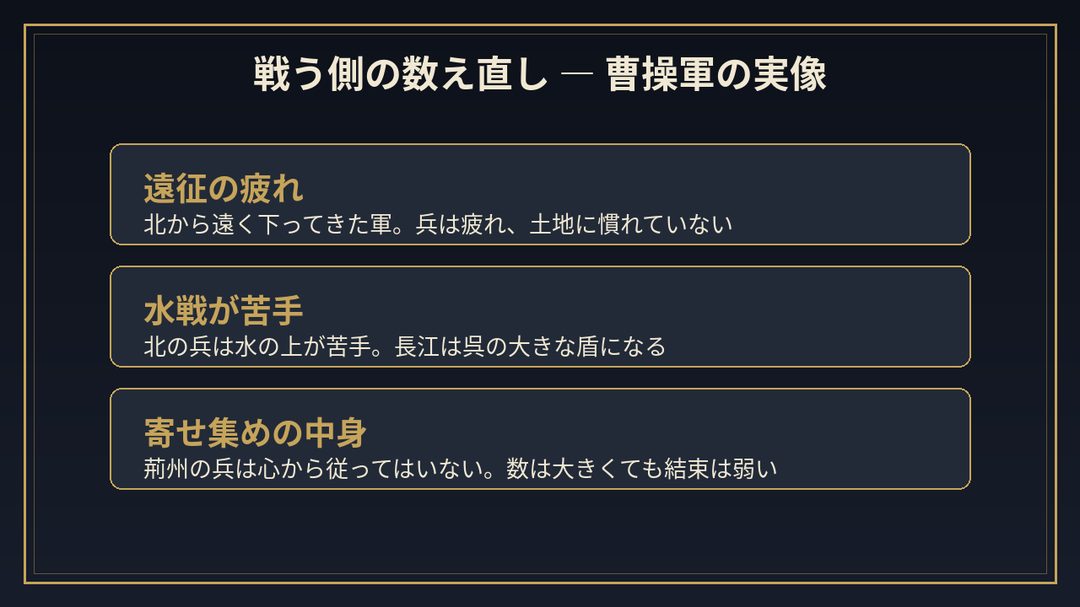
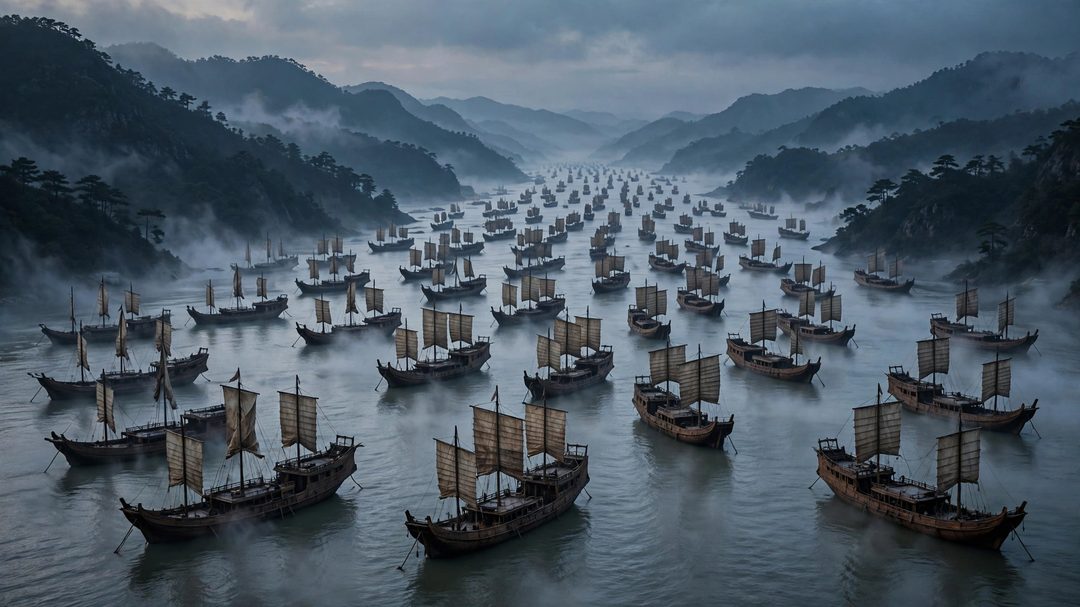
Next, Kongming rebuilt the gain and loss of the fighting side as well. Cao Cao's great army was an expeditionary force come from far in the north. Its soldiers were tired and unaccustomed to the land. Moreover, northern soldiers were poor at fighting on water. The Yangtze was still a great shield for Wu. Nor were Jing Province's soldiers following Cao Cao from the heart.
However large the number, its content was a makeshift gathering. Liu Bei, on the other hand, still had generals such as Guan Yu, Zhang Fei, and Zhao Yun, and had the strength to fight on even after defeat. Kongming changed the very way of comparing troop numbers. What should be counted was not heads, but whether they could fight. Here, too, the premise that fighting meant certain defeat collapsed.
The land of Jiangdong had long been ruled by the Sun house, and its soldiers and people knew the land. The defending side had the advantage of the terrain.
Sun Quan's Decision: Gain and Loss, and a Lord's Standing
However, it was not the senior officials who would decide the alliance, but Sun Quan himself. Before Sun Quan, Kongming showed, in addition to gain and loss, one more measure: surrender, and the people of the realm might call him a coward — a question of a lord's name and standing. For Sun Quan, surrender was not a safe choice.
It was the choice of ceasing to be a lord. On the road of fighting, by contrast, there was an ally in Liu Bei, and a path to victory could be drawn. The presence of generals with the resolve to fight, such as Zhou Yu, also pushed Sun Quan's back. When gain and loss, name, and standing were all in place, Sun Quan decided on the alliance. The Battle of Red Cliffs that followed stands upon this discussion.
Sun Quan was a young ruler. He could not, in his own generation, let go of the Jiangdong that his father and elder brother had built.
Conclusion: Three Patterns of Negotiation
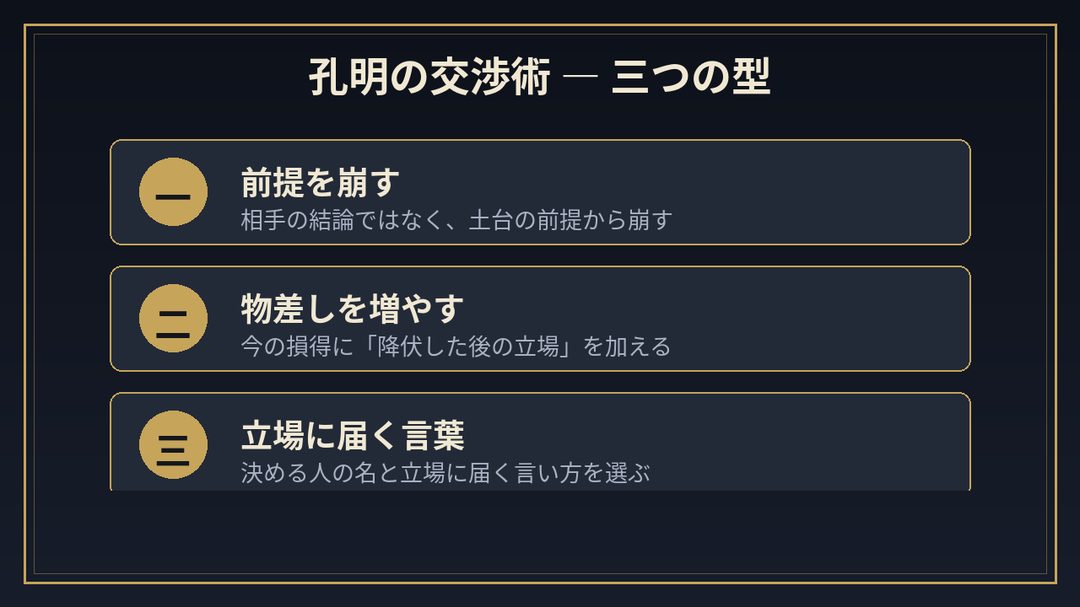
To sum up Kongming's art of negotiation, there are three patterns. First: break not the other side's conclusion, but its premise. He broke the premise that surrender would preserve them. Second: increase the measures of comparison. To the immediate gain and loss, he added one's standing after surrender. Third: choose words that reach the position of the person who decides.
To Sun Quan, he spoke in terms of a lord's name and standing. Talking someone down closes the other side's heart. But rebuild the gain and loss, and the other side can change its own conclusion. That is why the war of words before Red Cliffs is still told as a model of negotiation. What Kongming moved was not an army.
It was people's calculations. Words, depending on how they are used, move the state of a war before an army does. A discussion before a battle decides the battle's course. It was the war of words that Romance of the Three Kingdoms depicted.
Sources and Basis
The Source Story
Based on the war-of-words scene in Chapter 43 of Romance of the Three Kingdoms. The text is entirely this site's own summary and analysis; no long passages of the original are quoted.
Distinguishing the Romance from the Records
This article is a reading of a scene in the Romance. No comparison with the historical record has been made.